


Products and Services

500 liters or more per pillow pack
Currently, in the logistics sector, liquid packaging is predominantly carried out using steel drums, plastic drums, and tank containers—collectively referred to as rigid packaging. However, these empty rigid containers are bulky and cannot be compressed, effectively transporting “air” during delivery to end‑users. This results in high transportation costs, significant energy consumption, and environmental inefficiency. Consequently, there has been a growing trend toward replacing rigid packaging with flexible liquid bags. The most common examples include FIBC bulk bags, foldable heavy‑duty cardboard boxes, and detachable reusable crates. Yet, none of these three packaging formats can directly contain liquids; they must be lined with an inner bag that provides exceptional leak‑proof performance. Internationally, this inner liner is commonly referred to as a “liner.”
Category:
500 liters or more per pillow pack
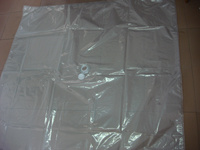
Today, liquid packaging—particularly in the logistics sector—primarily relies on steel drums, plastic drums, and tank containers. These containers are collectively referred to as rigid packaging. However, empty rigid containers are bulky and cannot be compressed, meaning that during transport to end‑user customers, they essentially carry “air,” resulting in high transportation costs, significant energy consumption, and environmental inefficiency. Consequently, there is a growing trend toward using flexible liquid bags as an alternative to rigid packaging. The most common examples include FIBC bulk bags, foldable heavy‑duty cardboard boxes, and detachable reusable crates. Yet none of these three packaging formats can directly contain liquids; they must be lined with an exceptionally leak‑proof inner bag, known internationally as a liner. Previously, most liners were flat‑shaped, commonly called “pillow‑type bags.”
Our company has developed a three-dimensional package—named the U‑shaped pouch—which consists of a flexible inner bag made from multi‑layer film and a sealed spout valve. The inner bag is crafted from composite films, with materials carefully selected to meet the requirements of various liquid packaging applications. For volumes of 500 liters or more, we offer large aluminum‑foil bags and transparent pouches, equipped with standard canning ports that support inkjet coding for product identification, and available in custom sizes and specifications.
Filler valve: Made from non‑toxic materials such as PP and PE, it offers reliable sealing and smooth operation. Available in butterfly, screw‑type, plunger, push‑button, and toggle designs. Filling can be performed manually, semi‑automatically, or fully automatically. With minor modifications to existing canning lines—by adding dedicated bag‑clamping and nozzle‑attaching devices—both continuous‑line and semi‑automatic operations can be achieved. Alternatively, specialized manual, semi‑automatic, or fully automatic equipment with single‑ or dual‑can filling heads is available; additionally, custom‑designed filling machinery and facilities can be developed to meet specific user requirements and conditions.
Advantages:
1. It is resistant to both acids and alkalis, and is sterile, non-toxic, and odorless.
2. Higher volume utilization, better compatibility with outer packaging, foldable design, lightweight, easy to store and transport, thereby reducing material storage and transportation packaging costs.
3. Energy-efficient and environmentally friendly, easy to recycle—simply separate the inner bag from the outer container for reuse.
4. It can achieve a product shelf life that is close to the expiration date, offering an extended shelf life and strong competitive advantage.
5. A variety of inner‑bag film materials and tap‑style dispensers have significantly broadened the range of liquid types that can be packaged and the scope of their applications.
Previous page
Next page
Previous page
None
Next page
Related products

undefined
Customer first, always ready to meet every need.
Address: No. 10 Lanxia Road, Industrial Concentration Zone, Moling Subdistrict, Jiangning District, Nanjing City
Postal code: 211111
Phone: 025-52166829
Email: hujianggs@163.com, hujiang@njhjgs.com

Copyright © 2023 Nanjing Hujiang Composite Materials Co.,Ltd. All rights reserved.
